
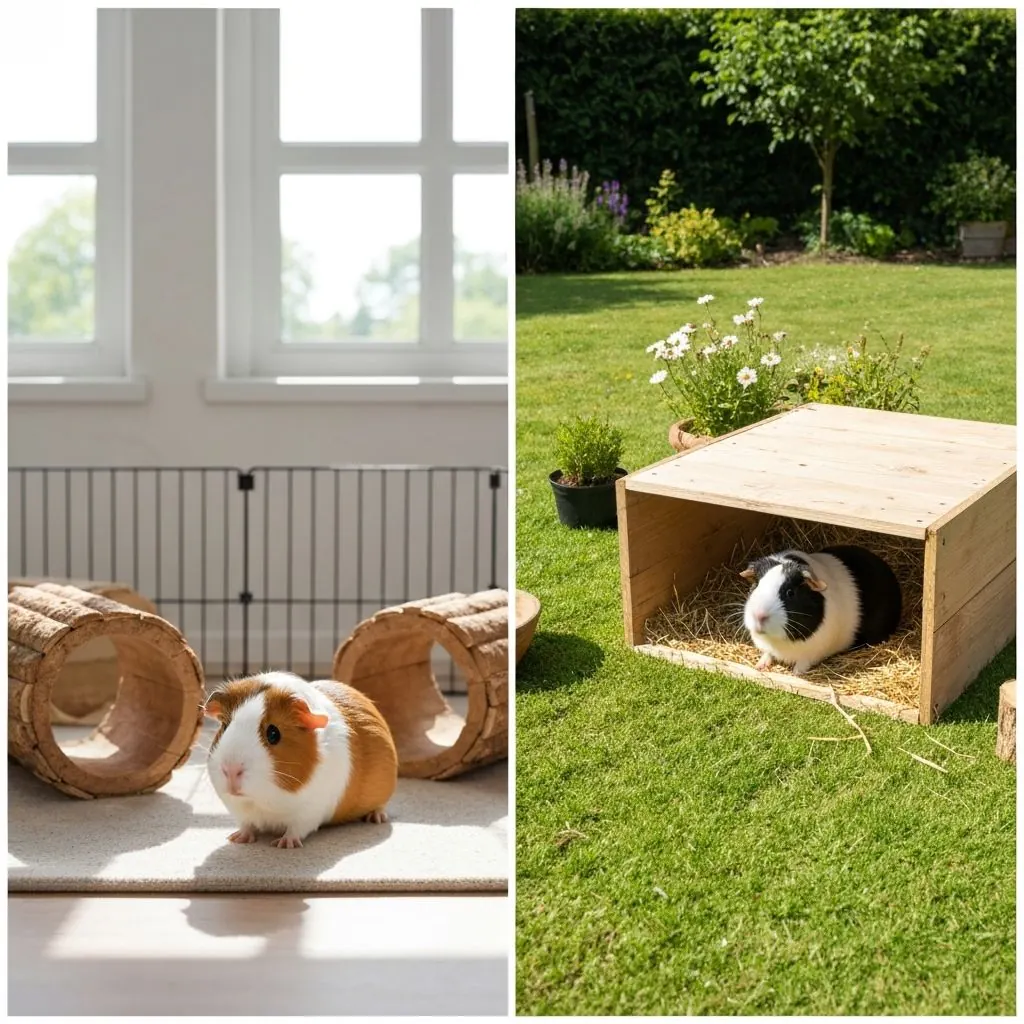
Indoor vs outdoor guinea pigs in the UK
Quick answer
Key facts
Indoor and outdoor guinea pig living can both work in the UK if space, protection from the elements, security, and routines are reliable.
- Garden setups need predator-proofing and a plan for heat and cold.
- Indoor setups need space, cleaning access, and enrichment.
- Heat, damp, and flies are major UK seasonal risks.
- Hybrid routines can work if transitions stay calm and gradual.
The question of indoor or garden living comes up constantly in guinea pig discussions, and the honest answer is that both can work well. Both can also be badly done. What matters is not which side of the back door your herd lives on, but whether their environment is actually safe, settled, and well managed for UK conditions.
The short version: indoors is easier to get right for most owners, because your home does much of the heavy lifting on heat and cold. A garden setup can be excellent, but only with proper shelter, solid locks, and a willingness to bring everyone in when the thermometer swings. This is the realistic version of that comparison, with the figures the UK welfare charities actually give.
The case for indoor living
Indoor living gives you some significant advantages in a British setting.
Steadier temperatures. British conditions are erratic. Indoor cavies are protected from sudden heat, unexpected cold snaps, and the kind of damp that creeps into garden structures over winter. You have control over the environment, and in most homes the rooms people are comfortable in suit them too.
Closer observation. When your guinea pigs share your living space, you see them more often. Small changes in appetite, movement, or behaviour are easier to catch when the animals are part of your everyday view. This matters, because they are a prey species and tend to hide illness until it is well advanced.
Stronger bonds. Proximity helps. Piggies that are around people regularly tend to become more comfortable with human presence, more vocal, and more interactive. That is better for welfare and better for the relationship, and it makes handling for nail trims and health checks much easier.
The trade-offs. Indoor setups take up real domestic space. Hay is everywhere. Ventilation matters. Cavies are not silent, and they will wheek every time the fridge opens. The smell of a poorly maintained indoor cage is hard to ignore. If you cannot genuinely fit a properly sized setup in your home, forcing the issue is no welfare gain.
Where you put the cage matters as much as having one. The RSPCA advises a spot that is well-ventilated, dry, and away from draughts and direct heat sources such as radiators or sunny windows. A conservatory is usually a poor choice for the same reason: it can overheat fast on a bright day, even in spring. Avoid rooms where a dog or cat can stare in all day, and keep the setup at floor level or on a sturdy stand, away from televisions and speakers.
The case for a garden setup
Garden setups can work brilliantly when they are designed properly.
More natural behaviour.Access to fresh grazing, daylight, and varied sounds and smells adds genuine enrichment. Guinea pigs who can graze safely on a clean lawn — introduced gradually, so the gut keeps up — are doing something very close to what their ancestors did. That is not nothing.
More space. Garden runs and sheds often allow for larger overall footprints than is practical in most homes. A properly set-up outbuilding with a connected run can give a pair or a trio far more room than any indoor setup in a typical UK home, and more room means more running, more popcorning, and fewer squabbles.
The trade-offs.Living outside requires a serious commitment to managing the elements. UK summers can become dangerously hot. UK winters bring damp, cold, and sometimes frozen water. Fly — and therefore flystrike — risk in warm spells is real, especially for any animal with hygiene issues. Predator-proofing must hold every single night, without exception.
A garden herd needs the same everyday observation as an indoor one, but the friction of going outside on a wet, dark evening to look them over means some owners do it less consistently. That is a welfare risk, and it is the one that catches people out.
UK temperatures through the year
Guinea pigs handle heat badly and sudden swings worse, so the numbers are worth knowing. The RSPCA says room temperatures of 17–20°C are ideal, that above 26°C they can suffer heatstroke, and that below 15°C they can become chilled. PDSA gives a similar ideal range of 15–20°C and notes that above 24°C can be uncomfortable, with heatstroke possible above 27°C. Either way, the comfortable band is narrow, and a British garden leaves it regularly in both directions.
A cheap thermometer in the room or shed, ideally one that records the day's high and low, tells you far more than guessing from the forecast. Put it at pig height, down where they actually sit.
Summer heat. Heat is the bigger danger for most UK herds. A shed or wooden box in direct sunlight can get far hotter than the air around it, and cavies cannot sweat their way out of it. The RSPCA advises that garden setups are sheltered from direct sun and wind, and PDSA suggests moving the hutch into a shady area and giving shaded spots in the exercise area.
On hot days, think about where the sun will be at three in the afternoon as well as at breakfast. Good airflow, plenty of fresh water, cool tiles or ceramic slabs to lie on, and shelters they can retreat into all help. If the forecast says the high twenties or above, bringing everyone in to the coolest room you have is usually the safest call. Remember that an indoor herd can overheat too, especially near a sunny window.
Warm spells are also flystrike season. Look over the back end of every pig at least twice a day in summer, clean out soiled bedding promptly, and pay extra attention to older, overweight, or long-coated animals that struggle to keep themselves clean.
Winter cold and damp.The RSPCA advises moving guinea pigs indoors when temperatures fall below 15°C, which in a British autumn or winter happens often. PDSA's advice is to bring them inside if temperatures drop, or, if that is not possible, to use a shed or a car-free garage. PDSA is blunt about why the garage must be car-free: car fumes could be fatal.
For a herd that stays in an outbuilding through the colder spells, PDSA recommends:
- plenty of hay or straw bedding to burrow into, changed regularly so it stays dry
- wrapping drinking bottles (bubble wrap or an old sock works) and moving the ball often so it does not freeze in place
- looking at water bowls at least twice a day
- leaving enough airflow if you use a waterproof cover or tarpaulin
- an animal-safe heat pad under the bedding, in a fabric cover to prevent burns
- no lawn time when it is cold and damp
Damp is the quiet enemy. Wet bedding chills a guinea pig quickly, so a dry, draught-free sleeping area matters more than any amount of extra fleece.
Switching between the two. The RSPCA notes that guinea pigs do not cope well with big changes in temperature, and that animals who have spent winter in the house should only go back out once conditions are right. PDSA likewise advises against moving indoor cavies out during colder months. In practice that means no sudden moves from a centrally heated lounge to a frosty garden, and a gradual changeover in late spring once nights stay mild.
Predators and security
Foxes and cats are the obvious threats in UK gardens, and PDSA asks for hutches and runs that are escape-proof and secure from prowling predators. The RSPCA adds that guinea pigs should be kept away from dogs, cats, ferrets and other animals they may see as a threat, and that because many of their natural predators are birds, they are easily alarmed by anything approaching from above.
That last point applies in the home too. A curious cat sitting on top of a cage is a real source of stress, even if it can never get in. For garden setups, sturdy weld mesh, bolts on every opening, a solid roof on any pen, and something to stop digging underneath all add up to genuine predator protection. A run left out overnight with nothing more than a lid and a hopeful attitude does not count.
Company is part of safety as well. The RSPCA says rabbits and guinea pigs do not make ideal companions, because a rabbit may bully or injure them. Keep cavies with other cavies, ideally at least one other friendly guinea pig, wherever they live.
Space, shelter and layout
Floor space matters wherever your herd lives. PDSA's guidance for garden accommodation is the bigger the better, but at least 1.5m by 1m with a 2m by 1m run attached, weatherproof and raised off the ground. The RSPCA asks for a space large enough to exercise in and high enough for them to stand up fully on their back legs, with around 30cm of height for youngsters to popcorn.
For an indoor setup, those figures are just as relevant; a pet-shop cage sold as “suitable for guinea pigs” is often far smaller. Many owners build a C&C pen or use a large indoor playpen to reach a decent footprint without taking over the whole room. Our main hutches and cages page covers sizes and layouts in more detail.
Within the space, give them multiple hideouts. The RSPCA advises that each guinea pig needs its own places to retreat, and PDSA suggests lots of tunnels, shelters and hides in the exercise space. Two cavies and one hide is a recipe for arguments. Add a hay rack or two, a heavy bowl or bottle for drinking, and room for laps between them.
Indoor setups also need a plan for mess. A washable floor or a waterproof base under the enclosure, a hay station that is easy to sweep around, and a cleaning routine you can keep up every week make the difference between a pleasant corner of the lounge and a smelly one. Fleece liners and paper-based bedding both work; what matters is that the floor stays dry.
Management, and the hybrid approach
The single most important factor in this comparison is not location. It is management.
An indoor guinea pig in a small cage who is rarely looked at, rarely cleaned, and living in a dusty corner is in a worse situation than a garden pig in a spacious, secure, well-sheltered shed with twice-a-day visits.
Conversely, a garden pig left in a summer shed with no shade and no ventilation while the thermometer climbs past the mid-twenties is heading for an emergency, regardless of how spacious the setup is.
Many experienced UK owners use a hybrid model: indoors for most of the year, a garden pen for supervised daytime grazing in mild summer conditions, and a move to a more protected indoor space during cold, damp, or extreme spells.
This is often the most practical approach for guinea pigs who started life indoors but benefit from seasonal access to the lawn. Keep the pen in the shade, bring them in well before evening, and stick to a lawn that has not been treated with weedkiller or fertiliser. Supervised means supervised: stay within sight, because a bird overhead or a neighbour's cat can turn a calm afternoon into a panic.
The practical list
Whichever setup you choose, make sure it delivers:
- enough floor space for the number and size of your guinea pigs
- steady, manageable temperatures year-round, with a thermometer to prove it
- predator-proofing if any time outside is involved
- observation every day, morning and evening, as part of a real routine
- easy cleaning access
- protection from draughts, damp, and direct sun
- a plan for where everyone goes during a heatwave or a cold snap
For the details of outdoor shed setups, read Sheds. For year-round weather planning, see Seasonal Care. For housing size and layout basics, visit Hutches and Cages.
Sources
- RSPCA: Where guinea pigs should live
- RSPCA: Guinea pig company
- PDSA: The ideal home for your guinea pigs
- PDSA: Keeping guinea pigs warm in winter
More on housing: guinea pig cage size UK, C&C cages for guinea pigs, how to set up a guinea pig cage and do guinea pigs need a run.
Frequently asked questions
- Can guinea pigs live outside all year in the UK?
- Some do, but it takes a well-insulated, weatherproof setup and close attention to temperatures. The RSPCA advises moving guinea pigs indoors when it falls below 15°C, and PDSA suggests bringing them inside, or into a shed or car-free garage, when it gets cold. For most UK owners, bringing them in for the colder part of the year is the safer plan.
- What temperature is too hot for guinea pigs?
- The RSPCA says temperatures above 26°C can cause heatstroke, and PDSA notes that above 24°C can be uncomfortable. Move them somewhere cooler and shaded well before it gets that warm.
- Can guinea pigs live in a garage?
- Only a car-free one. PDSA warns that car fumes could be fatal. The garage also needs ventilation and protection from damp and temperature extremes.
- Can guinea pigs live with rabbits?
- The RSPCA says rabbits and guinea pigs do not make ideal companions, as rabbits may bully or injure them. Keep guinea pigs with other guinea pigs.