
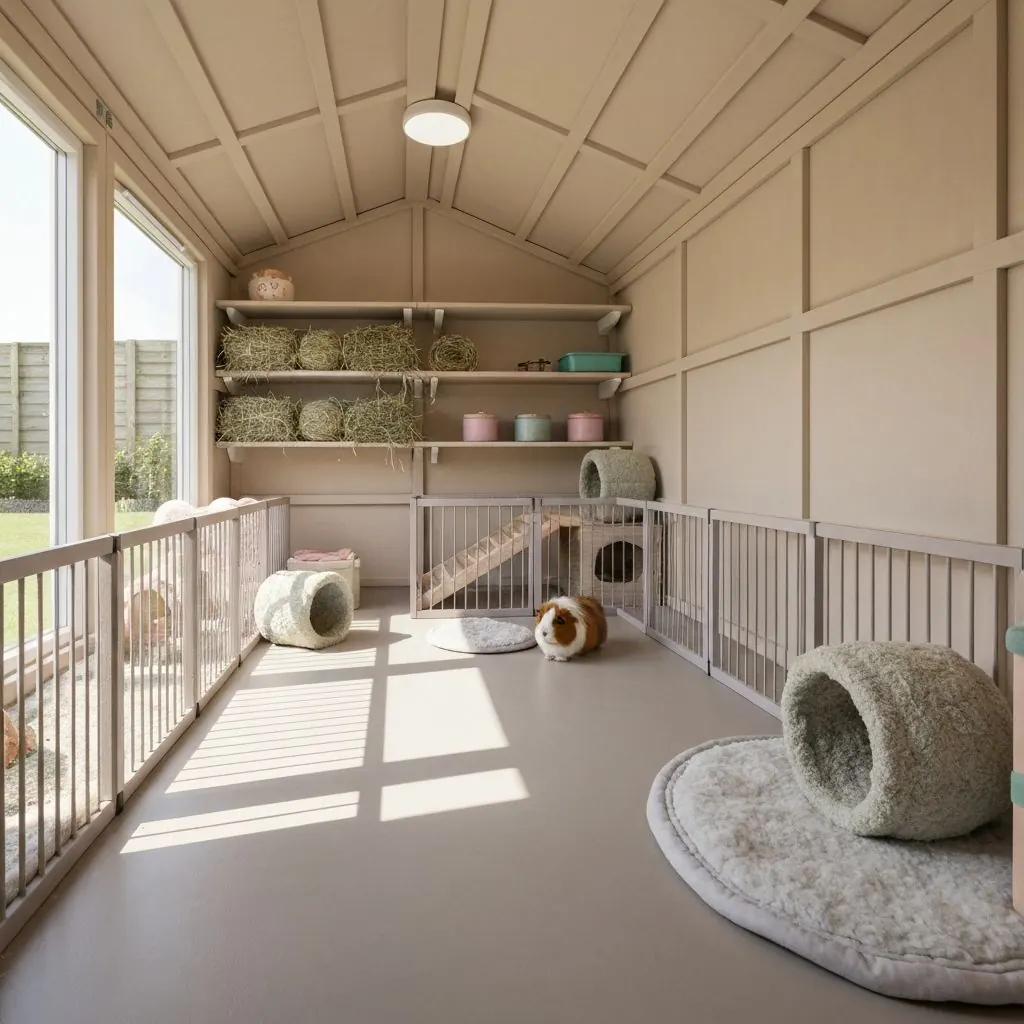
Guinea Pig Cage Size UK: How Much Space Two Guinea Pigs Need
Quick answer
Key facts
For two guinea pigs, the UK welfare charities that publish a figure start at about 5ft x 2ft (153cm x 61cm) of single-level floor space, and PDSA asks for more: a hutch of at least 1.5m x 1m with a 2m x 1m run attached. Treat those as minimums. The floor matters far more than height, and pigs also need a daily run.
- Wood Green: 5ft x 2ft for a pair of sows or a sow and neutered boar; 6ft x 2ft for two boars or a trio.
- PDSA: hutch at least 1.5m x 1m, with a run of at least 2m x 1m attached.
- Height: enough to stand up fully on their back legs, with free access to a run.
- Solid floors only. Grid floors can hurt their feet.
A cage for two guinea pigs should give them at least 5ft x 2ft (153cm x 61cm) of flat floor, and more is better. Wood Green Pets Charity uses that figure for a pair of sows, rising to 6ft x 2ft for two boars or a group of three. PDSA goes further, with a hutch of at least 1.5m x 1m plus a 2m x 1m run. Most cages sold as “guinea pig cages” are much smaller than any of these.
If the box says “suitable for guinea pigs”, take that as the manufacturer's opinion rather than a measurement. A tape measure settles it faster, and our hutches and cages guide explains how to lay it out once you have it.
What the UK charities actually say
There is no single legal minimum in the UK, and the main charities word their advice differently. Here is what each one published when we checked on 14 November 2026:
- Wood Green Pets Charity: hutch or indoor cage of 5ft by 2ft (153cm by 61cm), single tier, for a pair of females or a female and neutered male. For two males or a trio, 6ft by 2ft (182cm by 61cm). Garden run: 6ft long by 4ft wide by 18 inches high.
- PDSA: a large hutch, “the bigger the better”, of at least 1.5m x 1m, with a 2m x 1m run attached.
- RSPCA: no dimensions, but a secure space “large enough for them to exercise and high enough to stand up fully on their back legs”. Youngsters need around 30cm of height for their popcorning hops.
The PDSA figure is the most generous of the three: its 1m width is nearly 40cm wider than 2ft. If you are buying or building from scratch, aiming nearer the PDSA measurements costs little and saves an upgrade later.
Cage size for two guinea pigs, in plain numbers
A pair is the usual setup, since every guinea pig should live with at least one friendly companion. For a pair, the practical starting points look like this:
- Main living quarters with a separate daily run: 5ft x 2ft as a floor minimum.
- Living full time in one pen in the house with no separate run: closer to 6ft x 4ft, which is roughly the footprint of the Wood Green garden run.
- Two boars, or three or more pigs: start at 6ft x 2ft and go up. Wood Green notes that boars “tend to squabble” without as much room as possible.
A quick size chart
Here are the same space requirements side by side, converted so you can compare them with whatever is printed on the box. Metric figures are rounded.
- Wood Green, pair minimum: 5ft x 2ft, or 153cm x 61cm, about 0.9m².
- Wood Green, two boars or a trio: 6ft x 2ft, or 182cm x 61cm, about 1.1m².
- PDSA: a 1.5m x 1m hutch (1.5m²) plus a 2m x 1m run (another 2m²).
- Wood Green garden run: 6ft x 4ft, roughly 183cm x 122cm or 2.2m², with sides 18 inches (about 46cm) high.
Put a pet shop listing next to those figures and the gap is usually obvious. A 100cm x 50cm box, for example, offers 0.5m², a little over half the smallest recommended figure. Pick your size from the list first, then shop for something that meets it.
Why the floor matters more than height
Cavies are ground dwellers. They run in short bursts, popcorn when they are happy, and like to keep a solid wall nearby. The RSPCA describes them as active animals that need room to run, stand fully upright on their back legs and stretch out when lying down. None of that happens on a ramp.
Room also keeps the peace. The charity says that if there are not enough places to spend time apart, guinea pigs can become stressed and may bully lower-ranking companions, and it recommends refuge areas that outnumber the pigs by one. A longer pen gives you room for those extra hides, two hay stations and two water points without anyone being cornered.
Indoor pens versus outdoor hutches
Both can work. PDSA says guinea pigs can live indoors or outdoors “so long as they have enough space”, and the measurements above apply either way. The differences are about temperature and safety:
- Indoors, the RSPCA suggests a room temperature of 17 to 20°C, away from radiators, sunny windows and draughts.
- Outdoors, the hutch needs shelter from direct sun and wind, and it advises moving them indoors when it drops below 15°C.
- PDSA asks for a hutch outside to be weatherproof and raised off the ground, and warns that concrete or very hard run surfaces can give them sores on their feet.
- Inside the house, PDSA wants the hutch or pen on a non-slip, easy-to-clean surface that is not carpeted.
Many owners keeping pigs indoors use modular C&C cages because they make 5ft x 2ft or 6ft x 4ft easy to reach without a custom build. Outdoor setups and sheds are covered in indoor vs outdoor guinea pigs and the sheds guide.
Measuring what you already have
Run a tape measure along the inside of the base, wall to wall, and ignore anything that sits above floor level. Multiply length by width in metres to get square metres, then check the result against the figures above. Write the numbers down before you go shopping. It is much easier to turn down a pretty hutch on display when you know, in centimetres, what your pair needs.
If it comes up short, you do not have to replace everything at once. Workable fixes include:
- attaching a run to the side so your pair can come and go
- joining two units with a safe, solid-floored link
- moving everything into a panel pen indoors, which can grow a section at a time
A small hutch can still earn its keep as a short-term travel box for vet trips. As a permanent home it falls below the minimum figures every charity above publishes, however nicely it is styled.
Lining and keeping a bigger floor dry
A larger floor takes more bedding, so factor that into running costs. The RSPCA recommends dust-free, absorbent wood shavings with plenty of hay for tunnelling and hiding, and advises against softwoods such as pine, and cotton wool. PDSA lists shredded paper as another option and suggests adding extra in really cold weather.
Many owners with pens in the house use fleece over a thick layer, with a coroplast base under the panels to catch spills. Whatever material you choose, the job is the same: a floor that stays dry. PDSA says to remove any wet or dirty shavings promptly, before damp patches spread.
Keeping a big enclosure clean
More room means more to tidy, though it also spreads the mess out. The same RSPCA guidance advises spot-cleaning every day and a thorough clear-out at least weekly, with the exact routine depending on how big the enclosure is and how many live in it. PDSA describes daily, weekly and monthly cleans, and says to let your pair back in only once the hutch is completely dry.
A long, low layout is easier to reach into than a tall one. Most mess builds up where they spend hours eating, so keeping fresh hay at one end gives you an obvious place to start.
What to avoid when you shop
- Wire or mesh floors, which can hurt their feet.
- Pet shop “starter” cages that fit on a sideboard. Lovely sideboard; wrong animal.
- A hamster cage with a new label on the box.
- Shallow bases that let shavings scatter across the room every time they zoom past.
- Narrow doors that make it hard to lift anyone out safely or reach the far corners.
- Tall hutches where most of the room is upstairs.
- A single enclosed hide for two pigs, which invites a standoff over who gets it.
Once the floor is sorted, pick a bedding that keeps it dry, and read the first-time owners guide if this is your first pair.
More on housing: indoor vs outdoor guinea pigs UK, C&C cages for guinea pigs, how to set up a guinea pig cage and do guinea pigs need a run.
Frequently asked questions
- What size cage do two guinea pigs need in the UK?
- At least 5ft x 2ft (153cm x 61cm) of single-level floor, according to Wood Green Pets Charity, with more for two boars or a trio. PDSA recommends a hutch of at least 1.5m x 1m with a 2m x 1m run attached.
- Is a 120cm cage big enough for two guinea pigs?
- At 120cm it is smaller than the 153cm (5ft) length Wood Green recommends for a pair, so it falls short as a main home. If it is all you have, add a large run every day and plan to upgrade.
- How tall does a guinea pig cage need to be?
- Tall enough for every pig to stand fully on its back legs. Youngsters need around 30cm of height for their popcorning hops. Extra height beyond that adds little; the floor is what counts.
- Does a guinea pig need a run as well as a cage?
- Yes. They need free access to a run with pipes and shelters, and PDSA suggests a run of at least 2m x 1m attached to the hutch.
- Do three guinea pigs need a bigger cage?
- Yes. Wood Green suggests 6ft x 2ft for a trio or a pair of boars, and more room is always better for groups.
- Is a 5ft hutch big enough for 2 guinea pigs?
- A single-level 5ft x 2ft hutch meets the Wood Green minimum for a pair of sows or a sow and neutered boar, provided they also get a daily run. Two boars or a trio need at least 6ft x 2ft, and PDSA recommends more: 1.5m x 1m plus a run.
- Do lofts count towards guinea pig cage size?
- No. Count only the flat main floor. A loft or upper deck can add hiding and resting spots, but they need unbroken floor to run.
- What size cage does a single guinea pig need?
- Every guinea pig should have at least one friendly companion, so plan for a pair. A pig living alone for a short time still needs the same generous floor and daily run time.
Sources
- Wood Green Pets Charity, Caring for guinea pigs (checked 14 November 2026).
- PDSA, The ideal home for your guinea pig (checked 19 November 2026).
- RSPCA, Guinea pig environment and Keeping guinea pigs together (checked 19 November 2026).