
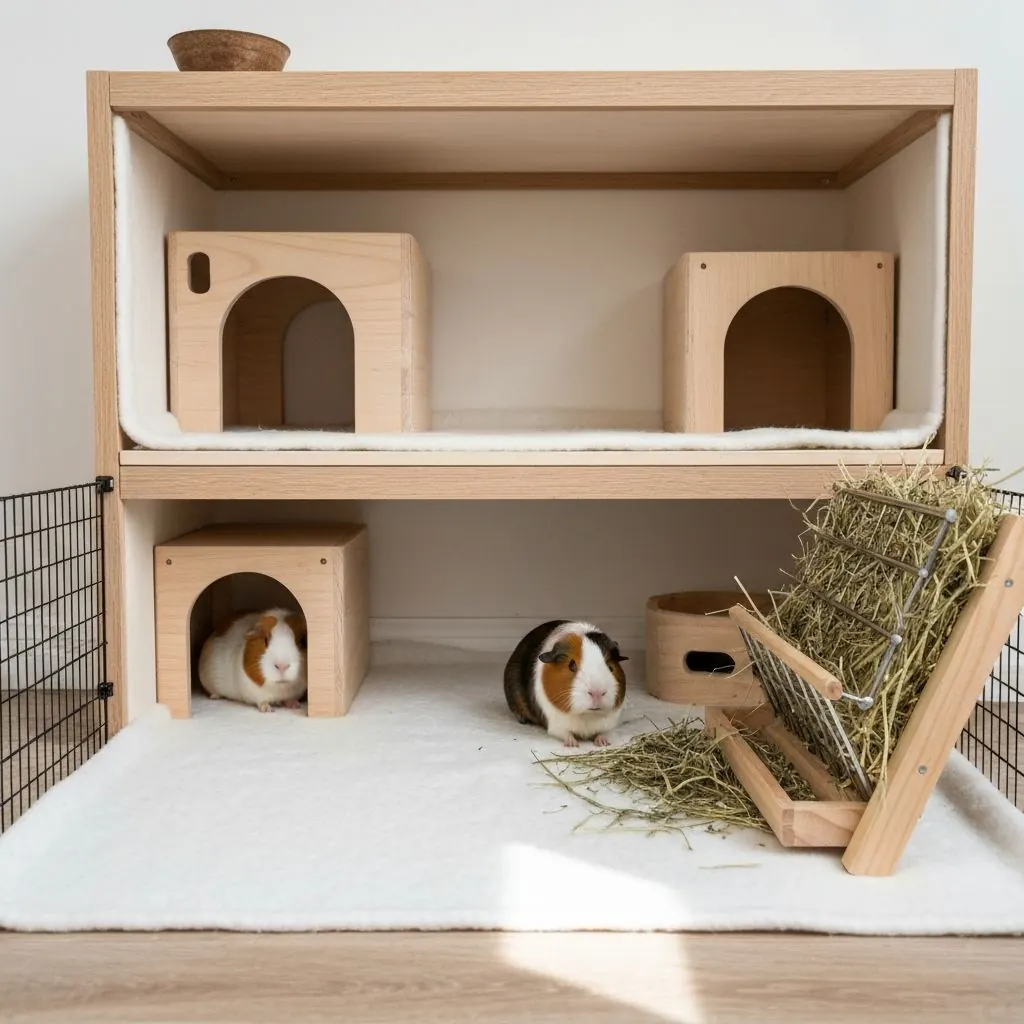
How to Set Up a Guinea Pig Cage: Layout, Hides, Hay and Water
Quick answer
Key facts
Put the cage in a quiet, draught-free room at 17 to 20°C, on a hard floor. Lay an absorbent base topped with plenty of hay, then add an enclosed sleeping area, one more hide than there are cavies, hay in several spots, water, a pellet bowl, a toilet corner and chew toys, leaving open floor to run.
- RSPCA: refuge areas should outnumber the guinea pigs by one, with room for all to hide at once.
- RSPCA: hay must be available at all times; check the water bottle daily for leaks or blockages.
- RSPCA: clean toilet areas every day and the whole home thoroughly each week.
- Avoid pine and other softwoods, grid floors and plastic chew toys.
Place the cage in a quiet room away from radiators, sunny windows and draughts, lay an absorbent base with deep hay on top, then fit an enclosed sleeping area, one hide per guinea pig plus one, hay, water, a food bowl and chews, leaving the middle open for running.
This guide is about the inside of the enclosure: what goes where, in what order, and how to keep it working day to day. If you are still picking the enclosure itself, our guide to hutches and cages covers the options, and the separate size guide has the charity floor figures. Everything below assumes you already have a roomy, solid-floored indoor pen or cage that meets them.
Before you start: the two zones every guinea pig needs
The RSPCA describes a guinea pig's home as having two main areas. The first is an enclosed, darkened area for sleeping, resting and hiding, big enough for the whole group to rest together comfortably. The second is a living area for activity, where they can explore, play, run and hide. Wherever possible, the charity says the two should be joined and permanently attached.
That shapes the whole layout. Cavies are active day and night for up to 20 hours, sleeping only in short bursts, so the RSPCA says they need access to everything at all times: food, water, companions, safe hiding places and toys. Nothing in a good layout is switched off at bedtime. You are designing a space that has to work at 3am as well as 3pm.
A simple way to plan it is to sketch the floor on paper first. Mark one end as the quiet end, with the main shelter and a hide, and the other as the busy end, with hay, water and the food bowl. The open floor in between is the running track. Then drop the extra hides and tunnels along the sides so no one is ever more than a short dash from cover.
Where to put the cage in your home
Location comes first because it is the hardest thing to change once the cage is full of hay. The RSPCA's advice is a spot that is well ventilated, dry and draught-free, and also safe, secure and free from hazards. Our indoor vs outdoor guide covers the bigger choice of house or garden; the points here are for picking the right room and corner indoors.
Temperature and heat sources
Keep the cage away from direct sources of heat such as radiators and sunny windows, and away from draughts. The RSPCA gives 17 to 20°C as the ideal room temperature, warns that above 26°C they can suffer heatstroke and below 15°C they can become chilled, and points out that in a centrally heated home some areas may get too hot.
A cheap room thermometer at floor level tells you more than guessing. Check it on a sunny afternoon and on a cold evening with the heating on before you commit to a corner.
Noise, other animals and foot traffic
The RSPCA suggests a quiet spot away from the television and music systems. Wood Green adds that a calmer area away from household noise and other pets such as dogs and cats helps their well-being, and that cats or dogs are more likely to watch them and cause stress. If you share your home with either, pick a room you can close.
Busy hallways and the corner next to the front door are poor choices too. Somewhere they can see and hear you, without people stepping over the cage all day, is the sweet spot.
The floor underneath
PDSA asks for indoor guinea pigs to be kept on a non-slip, easy-to-clean surface that is not carpeted. Hay works its way into the hallway, the sofa cushions and the turn-ups of your jeans, so a hard floor under the cage is a kindness to you as well. A washable mat or an offcut of vinyl round the edges catches the worst of it.
Laying the floor: base and lining
The floor of the enclosure itself must be solid. The RSPCA says not to use grid floors, as they let litter through and can hurt their feet, and asks for a solid floor with a good depth of litter. C&C pens get round this with a correx tray, so the grids form the walls and never the floor. Our bedding guides compare materials in detail, so this section is about the layers.
Layer one: something absorbent underneath
The RSPCA's booklet suggests lining the bottom with newspaper, then covering it with paper products or shredded, chipped, ground or pelleted products. Wood Green also starts with a thick layer of newspaper. Whatever you use, the RSPCA says it should be absorbent and safe to eat, and that softwood products such as pine should not be used as they can make them ill. It also advises against cotton wool and other fluffy products, and against coarse straw, which can cause eye injuries.
Layer two: hay on top
Lots of dust-free hay goes on top, says the RSPCA. Wood Green calls hay the most suitable lining of all and lays a good, deep layer over its newspaper. They tunnel, hide and graze in it, so a thick layer earns its keep in three ways at once.
If you use fleece
Fleece is a popular indoor lining, and Wood Green says it is fine as long as your guinea pigs have multiple piles of fluffy hay to graze from. It also says fleece needs changing every couple of days. Keep a spare so one can be in the wash while the other is down.
Hides: one per guinea pig, plus one
Guinea pigs are a prey species and need to hide when something scares them. The RSPCA says refuge areas should exceed the number of animals by one, and that there must be enough places for all your guinea pigs to hide at the same time. Wood Green asks for at least one hide per guinea pig, or more if you have room. For a pair, that means three hides at minimum, plus the main sleeping shelter. Starter kits that come with one hide for two pigs seem to assume guinea pigs enjoy queueing.
What makes a good hide
- Solid walls and roof for the main shelter. The RSPCA says these give a dark resting and sleeping area.
- Two ways out. Wood Green suggests cutting several guinea pig-sized holes in cardboard boxes for multiple entrances and exits, so no one gets trapped by a grumpy cagemate.
- Cheap and cheerful works. Wood Green lists cat carriers lined with newspaper and hay, upturned plant pots with hay or forage underneath, open-ended tunnels and bendy stick bridges. The RSPCA mentions PVC pipes, cardboard boxes and plastic shelters.
- Careful in hot weather. Wood Green warns that enclosed plastic igloos can hold the heat and cause heatstroke, so swap them for open wooden or cardboard hides on hot days.
Where to place them
Spread the hides out. One at each end and one along the side stops a single guinea pig guarding the only safe spot, and gives a nervous pig somewhere to go without crossing the whole cage. Leave the middle clear: the RSPCA wants room for them to run, stand fully upright on their back legs and stretch out when lying down.
The hay area
Hay is the most important part of the menu. The RSPCA says good-quality hay should make up the majority of a guinea pig's diet and must be available at all times, both for digestion and to keep teeth the right length and shape. Its booklet also says deep areas of hay, along with pipes and shelters, encourage them to exercise.
Racks, piles or both
A hay rack keeps a clean supply off the floor, while loose piles let them burrow. Wood Green suggests spreading hay around the whole enclosure, the run space and under hiding spaces. If you use a hanging basket or rack, Wood Green's tip is to keep it stuffed full of hay so legs cannot get trapped. With a pair or more, two hay spots at opposite ends mean the boss pig cannot block the only supply.
Water: bottle, bowl or both
The RSPCA asks for fresh, clean drinking water continuously, checked twice daily. Wood Green notes that many guinea pigs prefer to drink from a bowl, and that bottles are suitable but can often leak and be tricky to clean. Offering both covers you if one fails. A leaky bottle has a talent for soaking the one patch of lining you changed ten minutes ago.
- Bottle: fix it at a height your shortest guinea pig can reach comfortably, with the spout over a hard area rather than the hay. The RSPCA says to check it daily for leaks and blockages, and to clean the bottle and nozzle regularly to avoid contamination.
- Bowl: choose a heavy one that is hard to tip, and place it slightly away from the hay pile so it does not fill with bits.
- Every day: change the water at least once, says the RSPCA, and wash the containers before refilling them, as PDSA advises.
Food bowls for pellets and greens
A fresh portion of grass-based pellets should be available daily, as per the manufacturer's instructions, says the RSPCA, and it warns not to just top up the bowl. Pellets lose vitamin C over time, so tip out yesterday's and give a fresh portion. PDSA adds that any uneaten fresh food and nuggets should be thrown away so they do not go stale or mouldy.
A heavy ceramic dish for pellets sits well next to the hay area, and a second bowl or a clean patch of floor works for washed greens. With two or more, a wide bowl or two small ones lets everyone eat at once. Place food on the opposite side of the cage from the main sleeping shelter, so whoever is resting is not disturbed by whoever is eating.
The toilet corner
You can plan a toilet corner, but the guinea pigs get the final vote. Watch where droppings and wet patches build up over the first few days and work with that spot rather than against it: a low tray or an extra-thick pad of lining with some fresh hay in it is the usual approach. If they move the spot, move the tray.
Whatever you try, the RSPCA says toilet areas should be cleaned every day. Keep the toilet spot away from the water bowl and the main bed, and lift wet patches promptly, as PDSA advises. The RSPCA also lists altered toileting habits among possible signs of stress, so a sudden change is worth noticing.
Tunnels, toys and safe cage decoration ideas
Guinea pigs are intelligent and, says the RSPCA, need plenty of toys and activities so they do not become bored and suffer. They like to gnaw, chew and explore by moving from one area to another through tunnels. A good cage layout gives them plenty of reasons to move around.
Chews and gnawing
The RSPCA recommends tunnels and untreated wooden toys to chew, such as bits of fruit tree or willow sticks, which help wear the teeth down. Wood Green suggests apple or willow branches and twigs. The RSPCA asks owners to avoid plastic toys, as they may be harmful if chewed or swallowed.
Foraging
- Scatter forage mix through the lining to encourage foraging, as the RSPCA suggests.
- Wrap food in shredded paper or tuck hay into cardboard boxes, another RSPCA idea.
- Stuff toilet roll tubes with hay, or offer paper bags with the handles cut off (Wood Green).
- Offer objects to investigate, such as straw, wicker or seagrass mats, baskets and balls, which the RSPCA describes as great to investigate.
What to leave out
They are not very agile and are poor climbers, the RSPCA notes, and because they are inquisitive they can easily injure themselves on hazards in their surroundings. Skip steep ramps, high shelves without sides and anything with gaps that could catch a foot. Rotating a few accessories every week keeps things interesting without filling the floor; more stuff is not the same as more space.
Step by step: the order to fill the cage
Here is the order that saves the most back-tracking, from an empty cage to the first night:
- Check the room: temperature, draughts, heat sources and a hard, non-slip floor.
- Place the empty enclosure and make sure the base is solid, with no gaps in the grids.
- Lay the absorbent base layer, then a thick layer of dust-free hay or your fleece.
- Place the main sleeping shelter at the quiet end, away from the door you use most.
- Spread the other hides, one per pig plus one, along the sides.
- Fill the hay rack and leave loose hay piles at both ends.
- Fit the water bottle and stand a heavy water bowl on a hard spot near it.
- Set the pellet bowl near the hay area, away from the main bed.
- Pick a likely toilet corner and give it extra lining.
- Finish with tunnels, chews and one or two foraging toys, keeping the middle open.
- Walk round the outside and check every corner can be reached for cleaning.
Then let them in and leave them alone for a while. The RSPCA notes that they are naturally nervous of new sights, smells and sounds, and explore a new place very slowly, so do not worry if they spend the first few hours under a hide.
Your guinea pigs' daily check
Setting up the cage well is only half the job; the layout has to keep working. A short daily check catches most problems early.
Food, water and droppings
- Water: bottle not blocked or leaking, bowl clean and full, changed at least once.
- Hay: racks and piles topped up, with plenty left over.
- Pellets: yesterday's tipped out and a fresh portion given; old greens removed.
- Eating and droppings: the RSPCA asks you to monitor how much each guinea pig eats and drinks.
If eating or drinking habits change, if the number of droppings gets less or stops, or if there are soft droppings stuck to the back end or lying around the cage, the RSPCA says to talk to your vet straight away, as your guinea pig could be seriously ill. Do not wait to see if it settles.
Spot clean and weekly reset
Wood Green's daily routine is to pick up poo, wet hay and newspaper, replace bedding, change the water and remove uneaten greens from the day before. Its weekly clean sweeps the enclosure out and wipes it down with pet-friendly disinfectant, bowls and bottles included. The RSPCA recommends a deep clean at least once a week, but not so often that they are constantly disturbed. Monthly, PDSA suggests scrubbing the whole enclosure with a pet-safe cleaner and only letting them back in once it is completely dry.
One easily missed tip: because they have a strong sense of smell and scent-mark their home, the RSPCA suggests putting a small amount of the used lining back in after cleaning, so it still smells familiar and they feel less stressed. Our cleaning out guide covers the full routine.
Common cage setup mistakes
- Too few hides. Count the herd, add one, and make sure everyone can hide at once.
- Everything in one corner. A single feeding spot can turn into a standoff; spread hay and water out.
- Filling the floor. Hides, bowls and toys eat into running room, so leave a clear strip down the middle.
- Pine shavings or fluffy lining. The RSPCA advises against both.
- A cage next to the radiator. It feels cosy in January and turns into a problem the first warm afternoon.
- A lone guinea pig. The RSPCA says they are very social and need other friendly guinea pigs, so plan the layout for at least two.
Get those right and the details matter less. A plain, spacious pen with hay everywhere, enough hides and clean water is a better home than any themed cage packed with ornaments.
More on housing: C and C cages for guinea pigs, guinea pig cage size UK, indoor vs outdoor guinea pigs UK and do guinea pigs need a run.
Frequently asked questions
- How many hides do two guinea pigs need?
- At least three. The RSPCA says refuge areas should outnumber the guinea pigs by one, with enough places for all of them to hide at the same time.
- Should I use a water bottle or a bowl?
- Either can work, and many owners offer both. Wood Green says many guinea pigs prefer a bowl, while bottles can leak and are harder to clean. Check whichever you use every day.
- Where is the best place for an indoor cage?
- A quiet, dry, well-ventilated room at 17 to 20°C, away from radiators, sunny windows, draughts, loud speakers and other animals, on a hard floor rather than carpet.
- Can guinea pigs be litter trained?
- Not reliably. Place a tray or extra lining where they already tend to go, and clean toilet areas every day as the RSPCA advises.
- How often should I clean the cage?
- Spot clean every day and do a thorough clean at least once a week, according to the RSPCA, with a full scrub and dry roughly monthly as PDSA suggests.
Sources
- RSPCA, Guinea pig environment, Guinea pig diet and How to take care of your guinea pigs (booklet) (checked 21 November 2026).
- PDSA, The ideal home for your guinea pig (checked 21 November 2026).
- Wood Green Pets Charity, Caring for guinea pigs and How to make your guinea pigs feel at home (checked 21 November 2026).