
C and C Cages for Guinea Pigs: What They Are and How to Build One
Quick answer
Key facts
A C&C (cubes and coroplast) pen is built from storage-shelving panels for the walls and a folded sheet of correx as a waterproof tray. It makes a large, flat, single-level floor affordable, which is what UK welfare charities ask for.
- For two guinea pigs, aim for at least 5ft x 2ft (153cm x 61cm) of floor, the Wood Green minimum for a pair.
- Standard panels are about 35cm (14in) square, but brands vary, so measure yours.
- NAWT says gaps in the panels should be no more than 2.5cm.
- A loft is optional and does not count as floor space.
A C&C cage is an indoor pen made from storage-shelving panels and a correx tray, clipped together at home to whatever size you have room for. It is the cheapest common way to give two guinea pigs the 5ft x 2ft or larger floor that UK charities recommend, and it can grow later by adding panels.
The name comes from cubes (the wire panels sold for modular storage shelving) and coroplast (corrugated plastic sheet, usually called correx in the UK). Our hutches and cages guide lists them among the best indoor options.
Why UK owners rate them
Because nothing is fixed, you decide the shape: long and narrow along a wall, square in a corner, or an L that wraps round a sofa. You will find the panels sold flat-packed for shelving units in most homeware shops and online.
- Size for the money. Most pet-shop cages are far smaller than the 5ft x 2ft that Wood Green recommends for a pair.
- Flat floor. The RSPCA wants room to run, stand fully upright on their back legs and stretch out when lying down. A single-level pen gives all of it.
- Safety built in. NAWT notes the open sides give good ventilation, which lowers the chance of heatstroke, and the solid floor helps prevent bumblefoot.
- Easy to change and tidy. A few panels unclip to add space, and you can reach every corner. NAWT links dirty enclosures to many pet health issues.
NAWT recommends them for small pets, and points out that a setup which can grow with your family is likely to last longer. Wood Green Pets Charity uses a 6ft x 2ft C&C cage as its example indoor setup for a pair or trio, with multiple hiding spaces and willow chew toys. There is a downside: a big open pen takes up a fair bit of the room, and once you have seen a happy pair zoom the length of it, going back to something smaller feels unkind.
Sizing a C&C pen
Plan in squares. Standard panels measure about 35cm (14 inches) per side, but brands vary, so measure one before you draw anything.
For a pair
A 2 x 5 layout is about 70cm x 175cm. That clears the Wood Green minimum of 5ft x 2ft (153cm x 61cm) for two sows or a sow and a neutered boar. A 2 x 4 pen, about 70cm x 140cm, covers a similar amount of floor but is shorter than that 5ft length, and the extra square costs a couple of panels, so we would always add it.
For boars, a trio or bigger groups
Wood Green asks for at least 6ft x 2ft (182cm x 61cm) for two boars or a trio, which a 2 x 6 layout (about 70cm x 210cm) covers. It notes that boars tend to squabble without as much room as possible. Larger configurations such as 3 x 5 (about 105cm x 175cm) come in a little over the PDSA hutch minimum of 1.5m x 1m. For four or more, Wood Green says you will need a larger indoor setup or a converted shed.
What you need to build one
- Panels for the walls. Count the squares round the outside: a 2 x 5 pen needs 14, a 2 x 6 or 3 x 5 needs 16.
- Plastic connectors, plus zip ties to make each joint firm.
- A sheet of correx, cut so the edges fold up into a tray 10cm to 15cm deep.
- Duct tape for the folded corners, and a craft knife and straight edge to score the folds.
- Your chosen bedding, plus hides, a hay rack, a bowl for pellets and fresh water.
Check the panels before you buy. NAWT's advice is that gaps should be no more than 2.5cm, so small and baby piggies cannot get stuck or squeeze out.
How to build it, step by step
- Lay the panels out flat where the pen will live to check the layout.
- Stand the walls up and join them. NAWT says the panels slot together with connectors and can be further secured with cable ties.
- Measure the inside of the frame, add twice your side height to each dimension, and cut the correx to that size.
- Score the fold lines without cutting through, fold the edges up and tape each corner.
- Sit the tray inside the walls, so the plastic, not the mesh, is what the guinea pigs walk on. The RSPCA warns that grid floors can hurt their feet.
- Add your lining, hides, food and water, leaving open floor down the middle for running.
Correx scores and folds much like stiff card, so the trickiest part of the job is usually keeping the ruler still.
Lofts and stacking
A loft adds a lookout and somewhere to rest. The furrycritter build guide says a second level should be sturdy and easy to reach, with a ramp that is not too steep. Count only the flat main floor against the charity figures, though. If you want more room, the configuration options are better spent sideways: two extra squares in length give your pair far more running space than any shelf.
Where to put it in the house
- Somewhere well ventilated, dry and away from radiators, sunny windows and draughts. The RSPCA says 17 to 20°C is ideal, and that below 15°C guinea pigs can become chilled. Above 26°C they risk heatstroke, and parts of centrally heated houses can get too hot, so check the spot with the heating on.
- A quiet, calm room, away from dogs, cats, ferrets and other pets they may see as threats. The RSPCA says guinea pigs prefer routine and can become stressed around lots of noise and activity.
- On a hard floor. PDSA's advice is to keep indoor pigs on a non-slip surface that is not carpeted.
- If your herd usually lives outside, a C&C pen makes a handy winter home. PDSA suggests bringing them indoors to protect them from cold weather.
The cat will insist it only wants to watch, and the RSPCA's answer is to keep a constant eye on your guinea pigs if they are ever around a cat or dog, even ones you trust.
Lining, layout and cleaning
Charity advice differs on lining. PDSA lists dust-free wood shavings and shredded paper, while Wood Green prefers newspaper topped with hay and says fleece also works indoors, though it will need changing every couple of days. The RSPCA advises against softwoods such as pine, and against straw. Whatever you choose, PDSA says to clear out wet or dirty patches promptly.
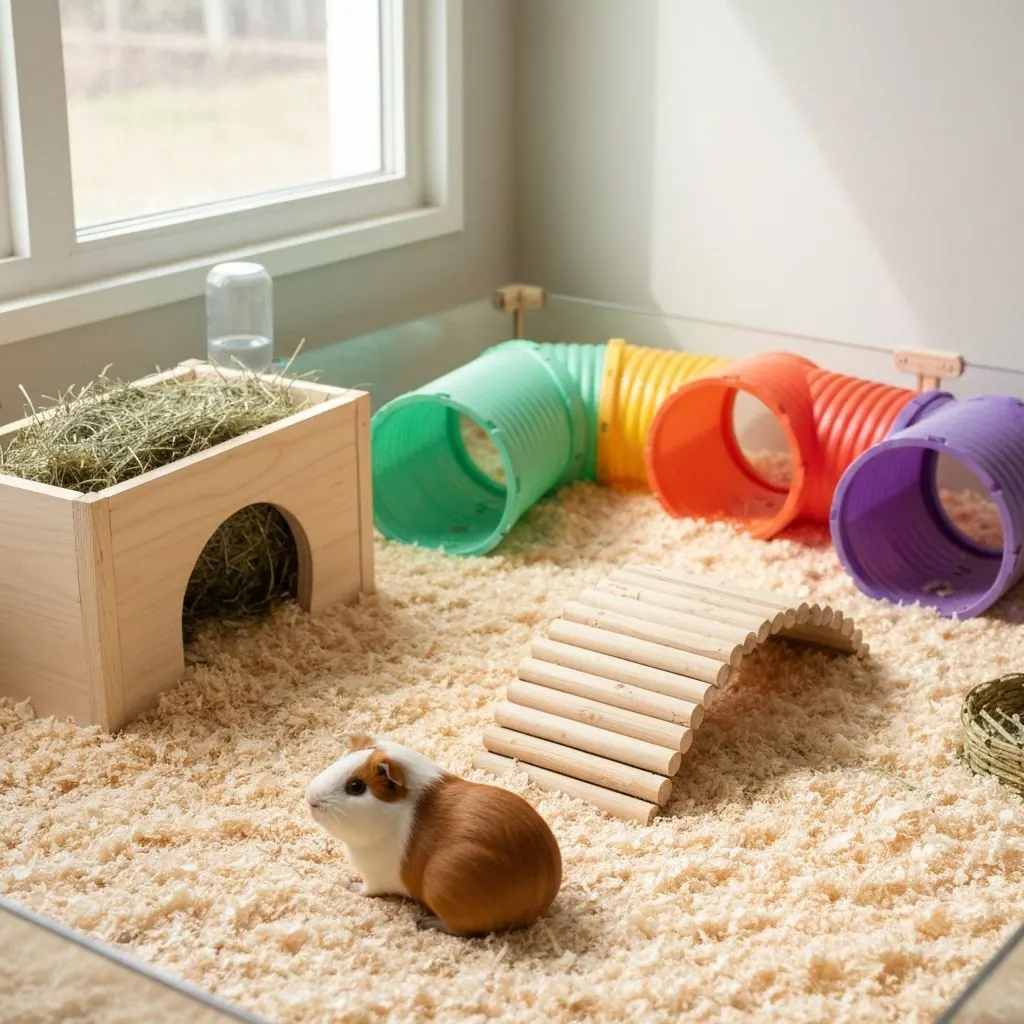
The RSPCA asks for refuge areas that outnumber the animals by one, with enough food, water and hiding places for everyone at all times. Wood Green suggests open-ended tunnels and hides, at least one per pig, and avoiding enclosed plastic igloos in hot weather. Spread them out so no one can guard the only doorway.
It recommends spot cleaning daily and a deep clean at least once a week, but not so often that they are constantly disturbed. Lift the tray out, scrub it with a pet-safe cleaner, and let it dry completely before anyone moves back in, as PDSA advises. Wash the food and water containers before refilling them. Their dinner gets everywhere, and a 10cm to 15cm lip on the tray is what keeps most of it off your floor. Our cleaning out guide covers the full routine.
Safety checks and mistakes to avoid
- Holes too big. Check every panel against the 2.5cm guide, especially with youngsters.
- Loose joints. A connector on its own can pop apart, so add cable ties.
- Walls too low. Young pigs need around 30cm of height for their popcorning hops, says the RSPCA. With a dog or cat at home, a lid or a second row of panels is cheap insurance.
- Mixing species. The RSPCA says rabbits and guinea pigs do not make ideal companions.
- A lone resident. The RSPCA advises at least one friendly companion, so size the pen for two.
- No quarantine plan. NAWT notes that a newly adopted piggy needs quarantining in a separate cage, and a few spare panels make a quick one.
A C&C pen still benefits from time out. The RSPCA would ideally give free access to an exercise area with pipes and shelters, and PDSA says indoor pigs need plenty of space to explore too. If you are torn between this and housing outdoors, our indoor vs outdoor guide sets out the trade-offs.
More on housing: indoor vs outdoor guinea pigs UK, guinea pig cage size UK, how to set up a guinea pig cage and do guinea pigs need a run.
Frequently asked questions
- What does C&C stand for?
- The two materials: storage-shelving panels for the walls and a corrugated plastic tray, sold in the UK as correx, for the floor.
- How many panels do I need for two?
- A 2 x 5 layout, 14 panels round the outside, clears the 5ft x 2ft Wood Green minimum for a pair. Boars or a trio need 2 x 6 or larger.
- Can you use a C&C pen outdoors?
- They are built for indoor use. Outdoors, PDSA asks for a weatherproof hutch raised off the ground and secure from predators.
- Is it better than a pet-shop cage?
- Usually, because it gives far more floor for the money. Any enclosure that meets the size figures, with a solid floor and enough hides, will do.
Sources
- Wood Green Pets Charity, Caring for guinea pigs (checked 19 November 2026).
- PDSA, The ideal home for your guinea pig (checked 19 November 2026).
- RSPCA, Guinea pig environment and Keeping guinea pigs together (checked 19 November 2026).
- National Animal Welfare Trust, 6 benefits of C&C guinea pig cages (checked 19 November 2026).
- Furry Critter Network, Building a C&C cage (checked 19 November 2026).