
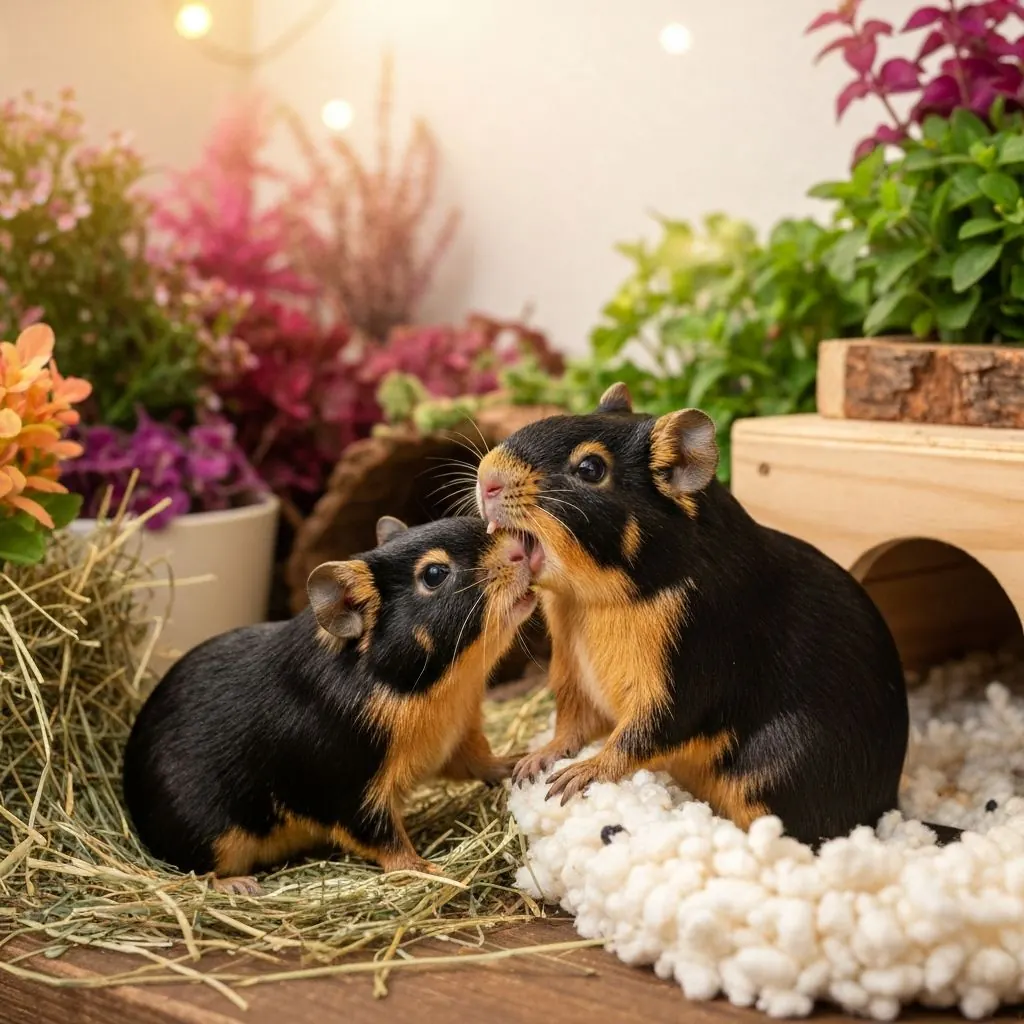
Guinea Pig Sounds and Body Language: What Wheeking, Purring and Chattering Really Mean
Guinea pigs talk all the time. A wheek usually signals food is coming, a low purr is contentment, a rapid clicking says back off, a rumble is a status display and a scream signals distress. Popcorning is joy and freezing is alarm. Together, these calls and postures express hunger, contentment, anxiety, annoyance and pain. The catch for owners is that the same call can have very different meanings depending on context. Once you know what to listen for, and what to watch alongside it, understanding your herd becomes considerably less mysterious.
Their talkativeness makes sense when you think about where they come from. Wild cavies live in groups in the grasslands and scrub of South America, where keeping in touch with the herd, warning each other about predators and sorting out who eats first all matter. Our domestic cavies have kept the whole repertoire, and they use it on us as well as on each other.
A few general rules make everything below easier. Look at the whole animal as well as listening. Notice what happened just before. And learn what is normal for each individual, because they vary a great deal: some piggies narrate every moment of the day, while others barely make a peep. Most guinea pig noises only make sense against that personal baseline.
None of this needs specialist kit or training. It needs you to spend time near the enclosure, ideally at different times of day, and to pay attention. Within a few weeks most owners can tell a dinner call from a complaint without looking up, and that skill is one of the best early-warning systems you can give a prey animal that hides illness so well.
The sound glossary
Here are the calls you are most likely to hear, with what they usually mean. Treat the right-hand column as a starting point, and check it against posture and context before deciding what is going on.
| Sound | Description | Usually means |
|---|---|---|
| Wheek | Loud, high-pitched, repeated squeal | Anticipation: food is coming, or you have been spotted |
| Purring (low) | Deep, steady, rolling vibration | Contentment, usually during gentle stroking |
| Purring (tense) | Higher-pitched and choppier than the content purr | Irritation or mild annoyance; check the posture too |
| Rumblestrutting | Deep, low rumble while walking stiffly and swaying | Status display, common in boars and also seen in sows |
| Teeth chattering | Rapid clicking of the incisors | Direct warning: back off |
| Whining or moaning | Soft, wavering complaint | Mild protest, often during handling or a nail trim |
| Chutting | Short, rhythmic little clucks | Contented exploring, often while pottering about |
| Chirping | Trilling, bird-like song, often while frozen still | Poorly understood; see below |
| Squealing or screaming | Loud, sharp, alarmed cry | Fright, injury or acute distress: check immediately |
| Cooing | Soft, gentle murmur | Reassurance between pigs, or a mother to her young |
| Hissing | Sharp exhalation | Strong warning; a lunge may follow |
Wheeking
The wheek is the signature call of the species: the loud, insistent squeal that erupts when the fridge opens, a bag rustles or a familiar person walks into the room. It is almost always about food, anticipation or excitement, and it can be startlingly loud for something so small. Many owners hear it before they are properly awake.
An animal who wheeks at you has learned that you are linked with good things. It is a compliment, if a rather noisy one. Pairs and groups often call in chorus, each one setting the others off, and many learn the exact cues that come before dinner: the crinkle of a veg bag, the fridge door, your footsteps on the stairs at the usual time.
You can use this. Saying the same word or making the same rustle every time you bring veg quickly becomes a cue, and a herd that comes running to a call is much easier to round up after floor time or check over each morning. Just do not reward every wheek with treats, or you will train a pair of tiny, very loud alarm clocks.
Wheeks that seem distressed are a different matter: prolonged, frantic, and not tied to feeding time. One calling persistently from a corner may be signalling that something is wrong with a companion or with themselves, so go and look. Equally, a usually vocal piggy who stops calling for food deserves attention. The RSPCA lists being quieter than normal and not eating among the early signs of illness.
Guinea pig purring
Guinea pigs have more than one kind of purring call, and the difference matters. The content version is low, steady and produced by an animal who is relaxed. You will often feel it as a gentle vibration through your fingers when stroking a comfortable animal sitting in your lap.
The annoyed version is higher, quicker and more jagged, and it often comes in short bursts. Posture tells you which is which. A relaxed one is soft, still and may have half-closed eyes. An annoyed one sits slightly raised, with twitchy skin, and may be turning toward whatever is bothering them.
There is a third kind worth knowing: a short, sharp burst, cut off abruptly, that some make when startled, often followed by freezing. It is closer to “what was that?” than a contented hum. If you are unsure which you are hearing, stop stroking and watch. A content animal will settle or nudge for more, while an irritated one will move away or escalate.
Most cavies have favourite spots, usually the forehead, cheeks and behind the ears, and plenty dislike being touched on the rump or belly. If the contented rolling note stops when your hand moves, you have found a spot they would rather you left alone. Let them tell you, and the stroking sessions get longer by themselves.
Chattering
Teeth chattering is the least ambiguous signal in the whole repertoire. The rapid clicking comes from the incisors, and it means one thing: back off. One who clacks their teeth at you is asking very clearly to be put down, to stop being touched, or for space from the animal they are facing.
Between companions, the clicking usually turns up during disputes over food, hides or status, often with raised hackles and a stand-off nose to nose. A little of it during introductions is normal. Prolonged clacking with lunging is a sign that things may tip into a fight.
Pressing on through the warning is how nips happen. The why guinea pigs bite article covers this in more detail.
Rumbling and rumble strutting
The rumble is a deep, low vibration, most often heard during a rumblestrut: a stiff-legged, slow walk with a swaying rear end, sometimes circling a companion. It is a status display, most commonly seen in boars, and it is aimed at the rest of the herd. It is a normal part of the social hierarchy and only becomes a concern if it escalates to persistent chasing, cornering or nipping.
Sows rumble too, and a sow in season may rumblestrut and mount her companions until it passes. A boar doing this at a sow is courtship, which is one reason neutering matters in mixed pairs.
A short rumble from an animal sitting still can be a sign of alarm or annoyance. If yours rumbles at a sudden bang from the kitchen, it is reacting to the bang, and flirting has nothing to do with it.
Chirping
Guinea pig chirping is one of the least understood calls in their repertoire. It is a high trill, rather like a songbird, that can go on for several minutes, and the singer often stays frozen still while doing it. It is relatively rare: plenty of owners never hear it at all.
Nobody really knows what it signals. Some owners connect chirping with stress, upset or the loss of a companion, and others with nothing obvious at all. With no reliable research to go on, the sensible approach is to treat it as a mysterious sound worth a closer look. Check the chirper over, check the companions, and note what was happening at the time.
If your chirper is otherwise eating, moving and behaving normally, there is usually no cause for alarm. Some owners record it on their phone, partly because it is so unusual and partly so they can play it to a vet or an experienced keeper later if anything else changes.
Squeals, whines and a loud scream
A sudden, sharp squeak means that your guinea pig is hurt, frightened or startled, perhaps by a companion nipping them, a slip or something that made them jump. A one-off yelp followed by normal behaviour is rarely serious. Repeated squealing, or a scream that goes on, is an emergency until proved otherwise: go and look straight away.
Softer complaints are much more common. Whining or moaning usually signals mild protest, heard when a companion pushes past or when you are doing something they would rather you did not, such as a nail trim. The chut, a series of short clucks, tends to come from a contented animal pottering about and investigating. Cooing is a soft reassurance call, most often from a mother to her young or between bonded companions.
Hissing is rare and serious. It is a strong warning, usually between companions, and it often comes just before a lunge.
If you hear a shriek from the enclosure, check both animals over before anything else. Look for scratches or bites around the face, ears and rump, and watch how each one moves and eats over the next hour. A single scuffle that ends with both of them eating calmly is normal herd life. Repeated screaming from the same individual, or wounds that keep appearing, means the pairing or the setup needs rethinking.
Postures and movement
Guinea pigs say at least as much with their posture as with their voices. Their faces do not change much, so watch the whole animal: how they stand, how they move, and where they position themselves relative to you and their companions.
Position in the enclosure tells you a lot on its own. A guinea pig who spends the day out in the open, eating and wandering, feels secure. One who only comes out when the room is empty, or always sits wedged behind the same hide, is still unsure of something, whether that is you, a companion or the room itself. Neither is wrong, but the second guinea pig needs more patience, more cover and a quieter spot.
Popcorning
Sudden, spontaneous jumps, sometimes mid-run and sometimes seemingly from nowhere, often with a twist or kick in the air. This is pure joy. An animal who popcorns is happy and confident. It is most common in youngsters, who can look like a malfunctioning wind-up toy, but plenty of adults keep doing it throughout life, usually in a slower, more dignified version.
Popcorning tends to happen when they feel safe and have room to move: floor time in a spacious run, fresh bedding, a new pile of hay. If yours never popcorn, it is not automatically a problem, but it may be worth asking whether they have enough space to get up speed. Zoomies, the sudden laps of the enclosure at full pelt, are the same mood expressed as cardio.
Older animals tend to popcorn less, and some stop altogether as they age or if their joints are stiff. A senior who used to bounce and no longer does may simply have mellowed, but if it comes with slower movement, less exploring or reluctance to climb ramps, mention it at the next vet check.
Freezing and bolting
Complete, sudden stillness, with all movement stopping and sometimes one foot still raised. This is a prey response: if they do not move, the predator may not notice them. A shadow passing overhead, the outline of a hawk, a sudden loud noise or an unfamiliar person can all trigger it, and a whole group may freeze together, then carry on as though nothing happened.
Bolting is the other half of the same instinct. A guinea pig feeling threatened will run for the nearest cover, which is exactly why every enclosure needs hides with more than one exit. A pair in a bare enclosure with nowhere to go have lost their main coping strategy.
Occasional freezing is normal. One who freezes or bolts frequently in what should be a calm room may be stressed by their surroundings: a barking dog, a cat that sits on the enclosure, a television at full volume. The RSPCA lists hiding most of the time, sitting hunched and reluctance to move among the signs of a stressed or frightened animal.
You can reduce startles with a few simple habits. Speak as you approach so they know you are coming. Reach in from the front and at their level, never swooping down from above like a predator. Keep the enclosure away from doors that slam and walkways where people rush past, and give each animal a hide of their own so nobody has to choose between safety and a companion.
Relaxed postures and faces
A relaxed cavy looks it. They lie stretched out on their side or belly, back legs kicked out behind them, sometimes flat out like a dropped slipper. They eat calmly, wander about, and groom themselves or each other without one eye on the exit. Sitting with front paws tucked under, in a neat loaf, usually signals comfort and rest.
Faces are subtler. Half-closed eyes during stroking suggest contentment. Guinea pigs can doze with their eyes open, so open eyes are no proof they are awake. Ears that relax and droop slightly go with a calm mood, while ears pricked and turned toward a sound signal alertness.
Sleep comes in short, frequent naps through the day and night, so an animal who looks like they never rest probably just rests when you are not looking.
Warning postures
Before any real squabble, guinea pigs usually puff themselves up. Watch for raised hackles (the fur along the back standing up), a stiff, stretched stance and a raised head. Two companions facing off nose to nose, each lifting their head to look taller, are having a status contest, and the one who lowers their head first concedes.
A wide yawn that shows off the teeth, aimed at a rival in a tense moment, is a threat display rather than tiredness. The same yawn on waking, followed by a stretch, is just a yawn. Context matters.
Other warnings include a sideways lunge, a quick snap at the air, and spraying urine at a rival, a deeply unpleasant but normal way of expressing disapproval. Most disputes end there, with one party stepping aside and both going back to eating as though nothing happened.
Nudging, sniffing and licking
A gentle push of the nose against your hand or a companion. Toward a person, it is usually “move your hand, I want to get past” or “stop stroking there”. Toward a cagemate, it can be investigation or the opening move in sorting out who goes first. It is a mild, polite signal, the piggy equivalent of a tap on the shoulder, and worth respecting before they escalate.
Sniffing is information gathering. An animal stretching their neck out to sniff something, back feet staying put in case they need to retreat, is curious but cautious. Licking your fingers is usually about salt or the remains of whatever you last ate, though some owners take it as affection and nobody can prove them wrong.
Mutual grooming between companions, nibbling gently around the ears and face, is a sign of a good bond. So is sleeping side by side, sharing a hide without fuss, and the soft chuts a guinea pig makes while following a friend around the run.
Pairs, groups and introductions
Most of this talk is aimed at each other, which is one more reason they need company of their own kind. Living in a pair or group gives them someone to call to, purr at and argue with, and much of what owners hear is the background murmur of a functioning herd.
In a settled group, the hierarchy shows in small ways: who eats first, who gets the best hide, who rumbles and who steps aside. Mounting, chasing, rumblestrutting and the odd squabble over food are normal, especially in the first weeks together or after any change. A lower-ranking animal who moves away when a companion approaches is following the rules, and that is fine.
Introductions are where reading behaviour matters most. Do them on neutral territory, with plenty of space, several hides with two exits and food in more than one place. Expect sniffing, rumbles, chasing and mounting while they sort out the pecking order. Those are the sounds of negotiation, and most pairs settle within a few days.
Signs that it is going wrong include sustained clicking teeth with raised hackles, lunging, locked rolling fights and any drawn blood. Separate them carefully with a towel or a board between them, never bare fingers, and give them a break before deciding whether to try again more slowly. One who hides constantly, stops eating or is never allowed to settle after the first few days also needs reassessing, even without any obvious fighting. Some combinations never work, and rescues can help match you with a better partner.
After the first meeting, keep listening for a while. A new pair that purrs at each other, eats side by side and flops out in the same room within a week or two is doing well. Constant rumbles at a companion who is trying to rest, or one animal always eating alone after the other has finished, suggests the balance is not right yet. Extra hides, a second water bottle and food spread around the enclosure often take the heat out of these early tensions, and the arguments usually fade once everyone knows where they stand.
When sounds and posture signal pain or illness
Guinea pigs are prey animals, and prey animals hide weakness. The RSPCA notes that guinea pigs feel pain but do not show outward signs of it, so they may suffer before you notice they are sick. That makes changes in behaviour and voice the most useful early warning you have.
Watch and listen for:
- loud squealing or screaming with no obvious social trigger
- a usually vocal animal who has gone quiet, or stopped calling at feeding time
- not eating, or eating much less
- hiding more than usual, sitting hunched, or reluctance to move
- squeaking when touched in one spot, or when moving
- constant scratching, crying out while scratching, or hair loss
- noisy or laboured breathing
Any of these is a reason to look more closely, and most are a reason to call an exotics vet. Any guinea pig that has stopped eating is urgent, because their gut relies on a constant flow of food.
Screaming with no obvious social trigger is a reason to call a vet. Intense, distressing cries can indicate severe mite infestation (which causes neurological distress) or injury. Mites and other skin diseases are miserable, and very treatable once diagnosed. The health warning signs page covers the physical symptoms to look for alongside changes in voice. More specific terms appear in the guinea pig glossary.
When you call the vet, describe what you heard and saw as precisely as you can: when it started, whether it happens when they eat, move, wee or are touched, and whether anything at home has changed. A short phone video of an odd call or posture can be surprisingly useful, because animals have a habit of behaving perfectly normally the moment they arrive at the surgery.
Reading sound and posture together
Individual noises and signals become much more readable when combined. A low purr from a pig lying flat with eyes half-closed is contentment. The same note from one facing a rival with a raised, stiff posture is a threat. A wheek with a run toward you is anticipation. A wheek from an animal huddled in the corner of the enclosure, refusing to move, needs investigating.
- Content: a low, steady hum, chuts, a relaxed stretched-out posture, eating and exploring.
- Excited: wheeks, popcorning, zoomies, crowding at the front of the enclosure.
- Annoyed: a choppy, higher-pitched note, a rumble, a nose-nudge, moving away from your hand.
- Warning: clicking teeth, raised hackles, a stiff stance, a yawn with teeth on show.
- Frightened: freezing, bolting, hiding, a sharp squeak.
- Unwell: quiet, hunched, not eating, hiding more than usual.
Your general care guide touches on the value of knowing each individual guinea pig's baseline: their normal calls and normal postures. That baseline is what makes changes visible.
Spend a few minutes each day simply watching and listening. Note who is the chatterbox, who sleeps where, and who barges to the food first. Many pet owners find they can tell their guinea pigs apart by voice within a few weeks, and the first time a usually noisy one is quiet at dinner, you will notice straight away.
Keeping a simple notebook or phone note helps, especially in the first months. Jot down anything unusual alongside weight, appetite and droppings. Patterns jump out that memory would miss: the sow who rumbles more every couple of weeks, the boar who sulks after nail trims, the pair who squabble only when the rack runs low. That record is the difference between vaguely worrying and knowing exactly what has changed.
New to guinea pigs? Our first-time owners guide covers the setup and routine that help a new pair settle in.
Sources
More for new owners: best guinea pig breeds for beginners, bringing new guinea pigs home, why guinea pigs bite and how to bond guinea pigs.
Frequently asked questions
- Why does my guinea pig wheek when they can see me but stop when I approach?
- This is usually anticipatory calling: they know you mean food is coming. The wheeking stops once the event arrives and they are busy eating. Perfectly normal.
- My guinea pig makes a sound I cannot identify. Where can I learn more?
- The best approach is to note the context: what was happening before the sound, what the guinea pig's body was doing, and what happened next. The sound rarely exists in isolation.
- Is it normal for guinea pigs to make sounds while sleeping?
- Very mild sounds during rest are normal. Loud, distressed vocalisations from a pig who appears to be sleeping would be unusual and worth checking on.
- Can guinea pigs recognise their names?
- They can learn to associate specific sounds with specific outcomes. Whether they understand their name as a concept is harder to say, but many guinea pigs respond to their owner's voice and to familiar tones in a way that goes beyond simple food conditioning.