
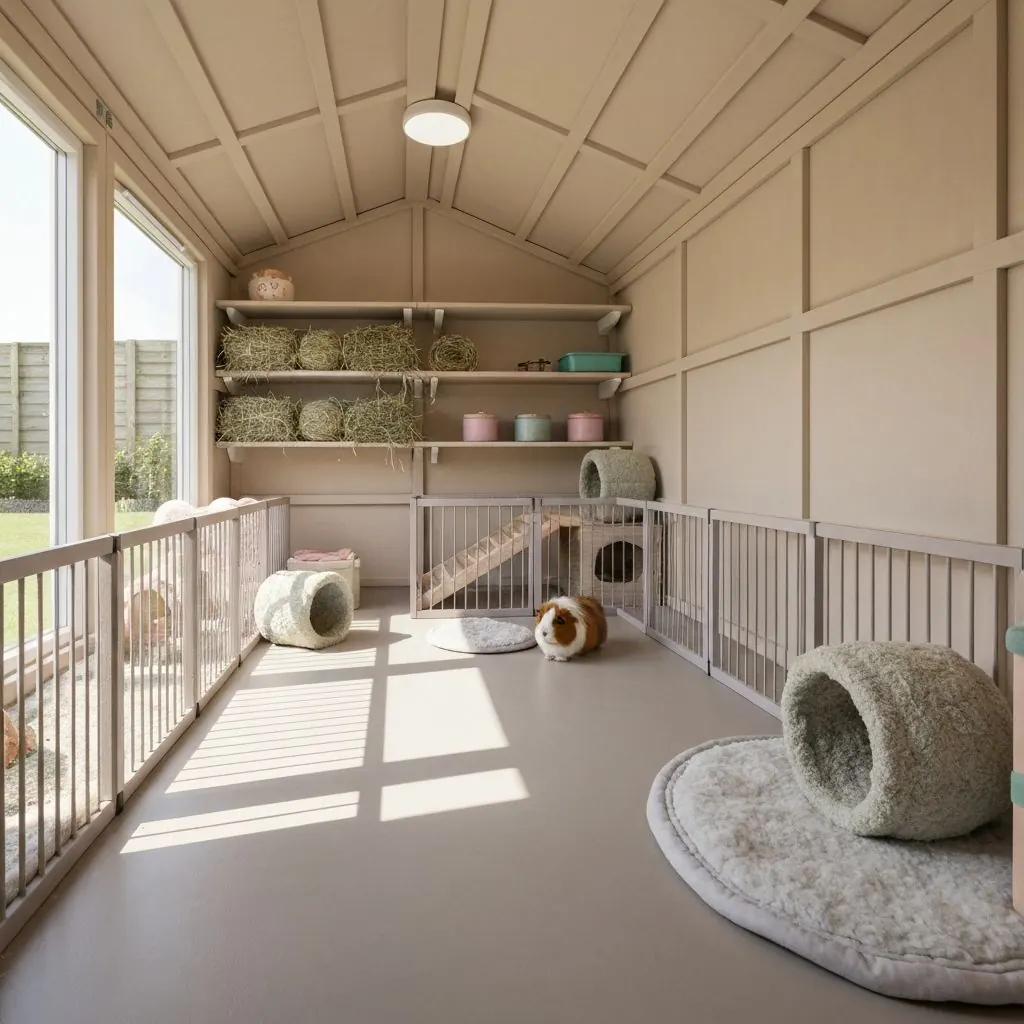
How to Insulate a Guinea Pig Shed: Lining, Floor, Windows and Bedding
Quick answer
Key facts
Wood Green Pets Charity's advice is to line the inside with large sheets of wood or plywood with insulation in between. The boarding keeps the warmth in and stops your piggies nibbling through to the insulation.
- Repair gaps, rot and snapped timber before you add any insulation.
- Lino over the floor makes cleaning easier and stops urine rotting the boards.
- Swap glass for small-gauge welded mesh fixed inside the frame; chicken wire is not suitable.
- Keep good airflow all year, and add extra bedding and snug hides when the weather turns.
To insulate a shed for guinea pigs, fix insulation to the inside and cover it completely with large sheets of plywood or timber, so there is no exposed edge to chew. Then line the floor with lino, swap any glass for mesh, stop low draughts without blocking the airflow, and pile in extra bedding.
A converted garden building is one of the best homes you can give a herd. Wood Green Pets Charity says the best protection for an outdoor enclosure comes from placing it inside a well-ventilated outbuilding with natural daylight, and for groups of four or more it suggests a larger indoor set-up or a converted garden building. Our guide to sheds covers choosing and setting one up; this page is about keeping it snug once the nights draw in.
Fix the structure first
Insulation only helps if the building itself is sound. Wood Green asks for no gaps, rotting or snapped wood anywhere in the structure. Walk round it on a wet, windy day and you will find the weak spots quickly: daylight round the door, damp patches in the corners, soft timber near the base.
- Stop the damp. Wood Green warns that a damp enclosure can cause serious health issues. A dry building is worth more than any lining you add later.
- Think about the base. Wood Green suggests moving the building onto a hard-standing surface. It stops your cavies chewing or burrowing underneath and keeps out predators that dig.
- Check the locks. Fit two sliding bolts on the outside, one of them at the bottom, so nobody can push the door open. Wood Green says swivel latches should not be used, as children and predators can open them easily.
There is little point lining a building that lets the rain in, and fixing the roof felt is a far less exciting job than choosing cosy hides, which is exactly why it gets put off.
Lining the inside so it cannot be chewed
Here is the core of the job. Wood Green's advice is to line the inside of the building with large sheets of wood or plywood with insulation in between. That sandwich does two things at once: the insulation keeps the warmth in, and the boarding stops your herd nibbling through to it.
Cavies gnaw. The RSPCA asks owners to provide untreated wooden chew toys precisely because chewing is part of keeping their teeth in shape, so assume any edge they can reach will be tested. The aim is that no insulation is visible or reachable from inside the enclosure.
- Measure each side and the ceiling, and plan where the sheets will join.
- Fix insulation to the inside of the frame, between the posts.
- Cover it with large sheets of plywood or timber, so there are as few seams as possible.
- Check every join, corner and cut-out at nose height. Any gap a tooth can get into is a gap that will be widened.
- Do the ceiling the same way. As PDSA points out, warm air rises.
We could not find charity guidance naming which insulation product is safest if a piggy does get at it, or how thick the boarding needs to be, so we have not invented a figure. Fully boxed in behind solid sheets is the safe principle whatever you use.
The same method works for a wooden Wendy house. Wood Green suggests steering clear of plastic children's play houses altogether, and it also warns that plastic pod or igloo hides can become very hot, which can be fatal.
Lining has a summer side too. Wood Green notes that wooden buildings retain heat, so good airflow is what keeps your herd comfortable on a hot afternoon. Insulation does not know what month it is, so plan the mesh door and windows at the same time as the lining.
The floor
Cavies sit low to the ground, and PDSA notes they can get cold and dirty on their bellies. That makes the floor as important as the sides.
- Lino on top. Wood Green says lining the floor with lino makes cleaning an easier task, and helps stop the floor rotting from urine.
- Raise the enclosure. PDSA suggests raising the enclosure off the floor, because warm air rises. Lifted up, they sit in the warmer layer.
- Solid, not mesh. The RSPCA wants a solid floor with plenty of litter and no grids underfoot.
Lino is also far kinder on the back when you are on your knees doing the weekly clean.
Windows, doors and draughts
PDSA warns that draughts from windows and doors can give your piggies chills, so these are the next spots to deal with. The trick is to stop the draught without sealing the building, because Wood Green says good ventilation should keep air flowing through all year round. Our separate ventilation post goes into airflow and condensation in detail.
Windows. Wood Green recommends replacing the glass and covering the opening with small-gauge welded mesh fixed to the inside of the frame. Chicken wire is not suitable, because predators can get through it easily. For the coldest nights, the PDSA advice on covers applies here too: a cover can go over the outside of the opening, as long as air can still get in.
Doors. Wood Green suggests turning the main door into a stable-style door with an inner mesh top half, so the top can stay open for air on milder days. A strip of wood across the bottom of the frame on the inside acts as a step-over barrier and stops escapes when you walk in.
If the building connects to a run through a tunnel or pop hole, that opening is another place air comes in. Wood Green says it should be big enough to walk through easily, so position the enclosure so the sleeping area is not directly in line with it.
Bedding, hides and the straw question
Insulation slows heat loss. The warmth itself comes from the animals, so they need deep bedding, snug hides, plenty to eat and company.
- More bedding. PDSA says to add extra bedding when the weather gets really harsh, and to replace it regularly so it stays dry.
- Stuffed hides. Wood Green suggests extra feeding hay for burrowing, stuffing the hides with it, and draping towels or blankets over them.
- Extra calories. PDSA and Wood Green both point out that they need more food to stay warm, so keep the rack full and keep up the daily fresh greens.
- Company. PDSA says a pair or herd huddling together keeps warmer than one on its own, which is one more reason never to keep a single piggy.
On straw, the advice differs. PDSA lists straw as a bedding choice, while the RSPCA advises against straw, along with softwood and cotton wool, for cavies. We follow the RSPCA here and stick to dust-free bedding they can safely eat.
Heat pads. For freezing nights, Wood Green suggests an animal-safe snuggle pad wrapped in a towel and placed under a hide. PDSA adds that any heat pad should sit under the bedding in a fabric cover to prevent burns, and that self-heating pads use the animal's own body heat and need no plug. Hardwired heaters are a different matter, and since the charities we checked give no guidance on wiring electrics into an outbuilding, we have not either.
Drinking. Bottles freeze. PDSA suggests wrapping them in bubble wrap or an old sock and moving the ball now and then so it does not freeze in place, and checking bowls for ice at least twice a day. Give the bottle a shake on the morning round, because the one time you skip it will be the coldest morning of the year.
When lining is not enough
A well-insulated building softens the weather, but there are limits. The RSPCA advises moving outdoor cavies indoors when it drops below 15°C. Our temperature post covers safe ranges and thermometers, so we will leave the numbers there.
- Older or unwell piggies benefit from living indoors through the colder months, Wood Green says.
- Do not just bring them in for the night. Wood Green warns that the swing in temperature can harm them; once in, keep them in until the weather is consistently warm.
- Indoor pets stay indoors. PDSA says moving indoor animals outside in colder months is not advisable, as a sudden change in temperature can make them unwell.
- Garages only if car-free. PDSA is blunt about this: car fumes could be fatal.
Check their health and weight regularly while temperatures fall, and if one seems unwell, Wood Green says to see a cavy-friendly vet.
More on shed set-ups: guinea pig shed temperatures and shed ventilation for guinea pigs.
Frequently asked questions
- What is the best way to insulate a shed for guinea pigs?
- Wood Green recommends lining the inside with large sheets of wood or plywood with insulation in between, which also stops them chewing through.
- Can guinea pigs chew insulation?
- They chew anything they can reach, so box the insulation in completely behind solid boarding and check every seam and corner.
- Should I seal every gap to keep the heat in?
- No. Stop low draughts from doors and windows, but keep the airflow. Wood Green says a converted building needs good ventilation all year round.
- Is an insulated shed warm enough on its own?
- Not always. Add extra bedding, snug hides and food, and the RSPCA advises bringing them indoors when it falls below 15°C.
Sources
- Wood Green Pets Charity, Converting a shed for guinea pigs, Cold weather tips for guinea pigs and How to house your guinea pigs (checked 21 November 2026).
- PDSA, Keeping guinea pigs warm in winter and The ideal home for your guinea pigs (checked 21 November 2026).
- RSPCA, Guinea pig environment (checked 21 November 2026).