
Shed Ventilation for Guinea Pigs: Fresh Air Without the Draughts
Quick answer
Key facts
Wood Green says a converted outbuilding needs good air flow all year round to help prevent respiratory illness, while the RSPCA and BSAVA both ask for housing that is dry and draught-free. The trick is moving stale air out above your herd while their floor stays still.
- Vet Times says airflow and cage cleanliness are particularly important for limiting ammonia build-up.
- Wood Green: wooden buildings retain heat, so airflow is what keeps guinea pigs comfortable in summer.
- Cover any opening with small gauge welded mesh fixed inside the frame. Chicken wire will not stop predators.
- RSPCA: spot clean daily and deep clean at least weekly. BSAVA says frequent bedding changes cut ammonia.
Good airflow carries ammonia and moisture out of a converted outbuilding, and draught control keeps that moving air off your cavies at floor level. Aim for openings above their heads, mesh over every gap, a floor that stays still, and bedding changed often enough that there is little smell to shift in the first place.
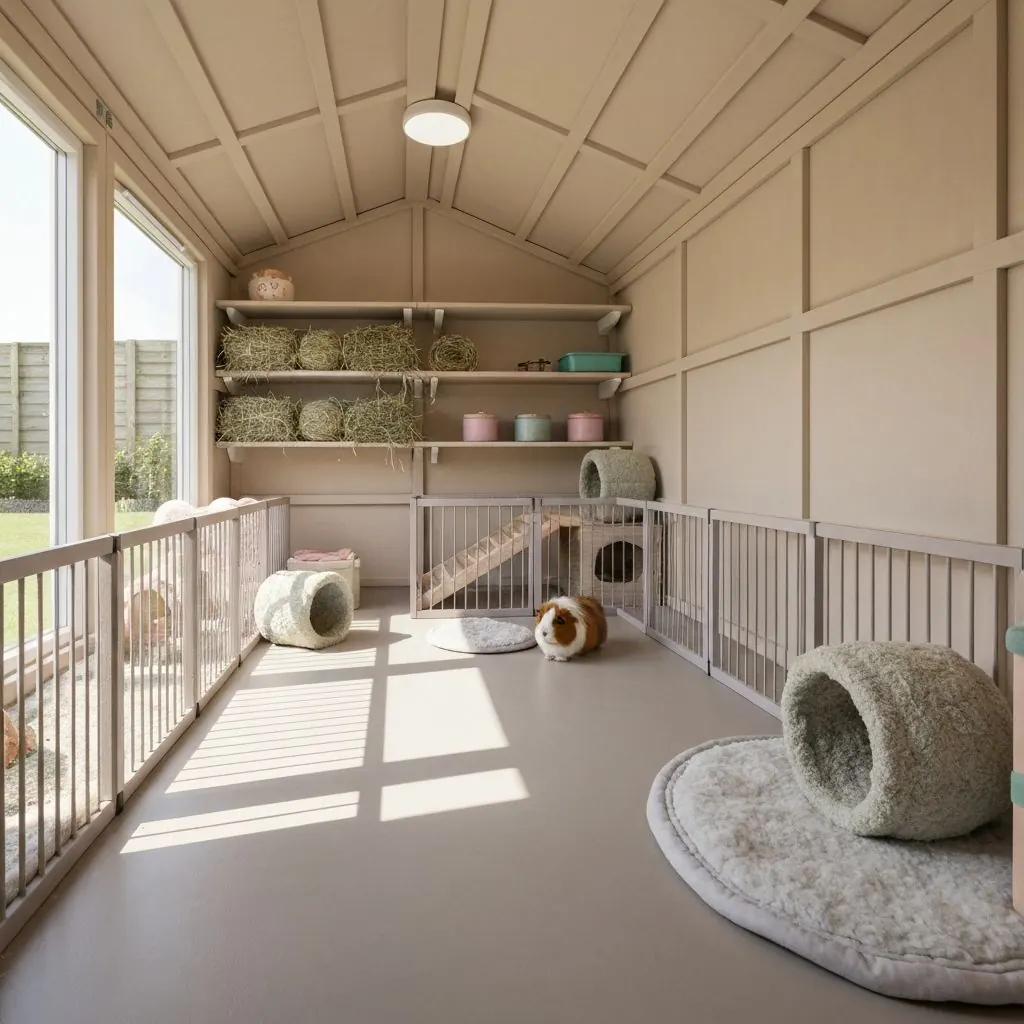
Wood Green Pets Charity calls garden sheds and wooden Wendy houses ideal homes for a herd, and its first step is simply a mesh door for fresh air. It also points out that a building like this offers more floor space, and so more room to explore. Airflow is one of the things our guide to keeping cavies in an outbuilding treats as non-negotiable, alongside security, insulation and a proper cleaning routine.
Why airflow matters so much
A closed wooden building with a few animals inside fills up quickly with three things you do not want: urine fumes, moisture and heat. Fresh air deals with all three.
- Ammonia. Urine soaked into bedding gives off ammonia. A Vet Times article on respiratory disease in rodents says ventilation and cage cleanliness are particularly important with respect to its build-up, and lists poorly ventilated, overcrowded housing among the housing problems that make breathing illness more likely.
- Moisture. Breath, water bottles and wet patches all add water to the air. Wood Green warns that a damp hutch can cause serious health issues, and says a dry, warm setting may reduce the risk of fungal and respiratory problems.
- Heat. Wood Green points out that wooden buildings retain heat, so good air flow is what keeps your herd comfortable through the summer months.
- Fumes from other uses. The BSAVA PetSavers guide says to avoid spots that carry a risk from fumes, such as smoking, fires or cars. Paint tins, fuel and the lawnmower are better kept somewhere else entirely.
Breathing infections are no small thing in guinea pigs. PDSA says an upper respiratory infection can quickly become fatal if left untreated, and will not clear up on its own. Clean air does not guarantee they never fall ill, but it takes one big risk off the list.
Moisture is worth measuring as well as smelling. BSAVA gives a relative humidity of 30 to 70% as part of ideal conditions for guinea pigs, and the Vet Times article suggests 45 to 55% for pet rodents generally. A simple hygrometer on the wall at pen height tells you whether the air is drying out between cleans or hanging heavy all day. If the reading stays high, more air needs to leave at the top, the bedding needs changing more often, or both.
Fresh air versus draughts
This is where conversions often get stuck, because the two sound like opposites. The RSPCA wants indoor housing to be well ventilated, dry and away from draughts, and BSAVA asks for an enclosure that is escape-proof, well insulated and draught-free. Both at once is possible, because the difference is about where the air moves.
The Furry Critter Network puts it neatly: the aim is to avoid cold currents blowing directly onto your herd, and the goal is never to seal them in completely, because that traps ammonia and stale air. In its words, you want breeze, not wind. A sealed, stuffy outbuilding is sometimes mistaken for a cosy one, and the smell when you open the door on a winter morning is usually the giveaway.
To test a spot, the same guide suggests holding your hand near the pen and feeling for air movement. Down at their level you should notice very little. If you feel a steady stream across the floor, move the pen, block the gap or raise the sleeping area.
Openings high or low?
None of the UK charity pages we checked gives an exact size or height for vents, so treat this as practical reasoning from their draught guidance. Hot, moist air rises, and the colder air sinks, as Furry Critter notes. Openings placed high up let stale air escape well above your herd, while the air down at floor level stays calm.
- Up high: mesh panels near the roof line, a top-hinged window, or the upper half of a stable door. Wood Green suggests cutting the outer door in half so the top can stay open, with an inner mesh door behind it.
- Down low: keep openings at floor level to a minimum where the pen sits. A vent fitted right at nose height simply pipes cold air across their beds all night.
- Raise the pen: BSAVA notes hutches and cages may be raised off the ground to avoid damp and draughts, which also lifts sleeping spots out of the coldest layer of air.
- Give them cover: hides with plenty of hay let your cavies choose a still corner when the air is moving. Wood Green suggests filling hides with soft hay in cold weather.
Winter changes the balance a little. Wood Green's cold-weather tips focus on keeping frost and wind out, especially around doors and windows, and a dry bed matters more than ever when they spend longer tucked up. In practice that means sealing low gaps and fitting the lower half of a stable door snugly, while leaving some high mesh open so moist air still has a way out.
Insulation and moving air work together rather than against each other, but the detail of lining the walls is a job of its own, covered in our sibling guide below. The same goes for safe temperature ranges.
Light comes in through the same openings. Wood Green describes the best protection for a hutch as placing it inside a well-ventilated outbuilding with natural daylight, so mesh panels that let in both air and light earn their place. Keep an eye on what can be seen through them, though. The RSPCA notes that many of their natural predators are birds, so guinea pigs are easily alarmed when approached from above, which is one more reason to keep hides spread across the pen below any roof-level mesh.
Mesh windows and doors that keep predators out
Every opening you add is a door for a fox, rat or stoat if it is not done properly, and guinea pigs have no way to defend themselves once something gets in. Wood Green lists foxes, stoats and rats among the wild predators that threaten an insecure setup, and its conversion guide gets specific.
- Windows: replace the glass and cover the frame with small gauge welded mesh, fitted to the inside. Chicken wire is not suitable, as predators can get through it.
- Mesh grade: Wood Green recommends strong welded mesh, ideally 16 gauge or less.
- Door: a wooden-framed inner mesh door lets the main door stand open on hot days while the herd stays safe inside.
- Locks: two bolts on the outside, one of them at the bottom. Wood Green says swivel latches should not be used, because children and predators can open them easily.
- Base: stand the building on hard standing so nothing can dig in from below.
- Escape barrier: a step-over board fixed inside the door frame stops a quick escape while you are going in and out.
BSAVA also lists birds of prey among the predators to plan for, and asks that wild rodents and birds cannot get in at all, because they can carry disease. Mesh with small holes handles both jobs. Foxes are patient and remarkably good at finding the one panel you meant to fix next weekend, so check the fixings now and then.
Summer airflow
On a hot day a closed timber building can turn into an oven, which is why Wood Green leans so hard on air movement in summer. With mesh doors and windows in place you can open everything up during the day and still lock the outer doors at night.
Wood Green suggests a rotating fan in a converted outbuilding, large hutch or indoor room, with any wires tucked away or covered with cable protectors. It also advises plenty of airflow for a gentle breeze, houses with more than one entrance so hot air can move through, and fresh piles of hay to burrow in.
Shade the outside where you can. PDSA says to never leave small pets' homes sitting in direct sun, and to keep an eye on where the sun moves through the day. Wood Green warns that plastic play houses and plastic igloos can get very hot, so swap them for wooden or fabric hides in summer.
Anything they can reach counts as food until proven otherwise, cables included, so run fan leads well outside the pen. Wood Green lists fast breathing, drooling, confusion, lethargy, loss of balance, loss of appetite, seizures and unconsciousness as heatstroke signs. If you suspect it, call a vet who sees cavies immediately and move them somewhere cool and shaded, but do not put them in cold water.
Keeping the air clean
Vents only move air around. The cleaner the bedding, the less there is to move. BSAVA says bedding needs changing frequently to keep things dry and to reduce the build-up of ammonia, and adds that glass tanks are poorly ventilated and need cleaning more often for exactly that reason.
- Daily: the RSPCA says spot cleaning should be carried out every day. PDSA says to get rid of any wet or dirty bedding, and Wood Green stresses daily spot cleans in winter, when they spend more time in their beds.
- Weekly: the RSPCA says accommodation should be deep cleaned at least once a week on average.
- Regularly: PDSA says to scrub the housing thoroughly with a pet-safe cleaner and only let your herd back in once it is completely dry.
- Floor: Wood Green suggests lino on the floor, which makes cleaning easier and helps stop urine rotting the boards.
- Bedding: PDSA asks for dust-free lining and suggests paper bedding or fleece, and the BVNA's Veterinary Nursing Journal advises avoiding straw and sawdust, linking them to eye injuries and respiratory disease.
Cleaning is the dull half of fresh air, and the half that makes the bigger difference to how the place smells. Our cleaning out guide sets out a full routine.
Signs the air is not right. Your nose is the first warning system. A sharp, eye-watering smell when you open the door means ammonia is building up faster than it is clearing, so clean more often and add higher openings. Water running down the inside of the windows, mould on the timber or bedding that never seems to dry all point to wet air with nowhere to go.
Then there are the guinea pigs themselves. PDSA lists nasal discharge, laboured breathing, sneezing, coughing, wheezing, loss of appetite and weight loss as signs of an upper respiratory infection, and says to see a vet as soon as you notice them. Do not wait to see whether a fix to the airflow sorts it out first. Mend the setup and book the appointment at the same time. The Vet Times article also advises isolating sick animals, and PDSA notes that respiratory infections can spread between piggies, so ask your vet whether the patient should be kept apart while it recovers.
More on shed set-ups: insulating a guinea pig shed and guinea pig shed temperatures.
Frequently asked questions
- Does an outbuilding for cavies need vents?
- Yes. Wood Green says good air flow is needed all year round to help prevent respiratory illness. A mesh door or mesh-covered windows are its starting point.
- How do I stop the fresh air becoming a draught?
- Put openings up high, keep the floor where they sleep still, raise sleeping areas and give plenty of hay-filled hides. Feel for moving air at their level.
- Can I just leave the door open?
- Only with a secure inner mesh door in place. Wood Green suggests small gauge welded mesh in a wooden frame, never chicken wire.
- Is a fan safe in summer?
- Wood Green suggests a rotating fan for converted outbuildings in hot weather, as long as every wire is tucked away or covered so it cannot be chewed.
Sources
- Wood Green Pets Charity, Converting a shed for guinea pigs, How to house your guinea pigs, Cold weather tips and How to care for small pets in the hot weather (checked 21 November 2026).
- RSPCA, Guinea pigs: environment (checked 21 November 2026).
- PDSA, The ideal home for your guinea pigs, Five common health problems and Summer dos and don'ts (checked 21 November 2026).
- BSAVA, PetSavers guide to guinea pigs (checked 21 November 2026).
- Vet Times, Elisabetta Mancinelli, Respiratory diseases in rodents (checked 21 November 2026).
- BVNA Veterinary Nursing Journal, Volume 39 (5), October 2024, page 46 (checked 21 November 2026).
- Furry Critter Network, Avoiding drafts (checked 21 November 2026).